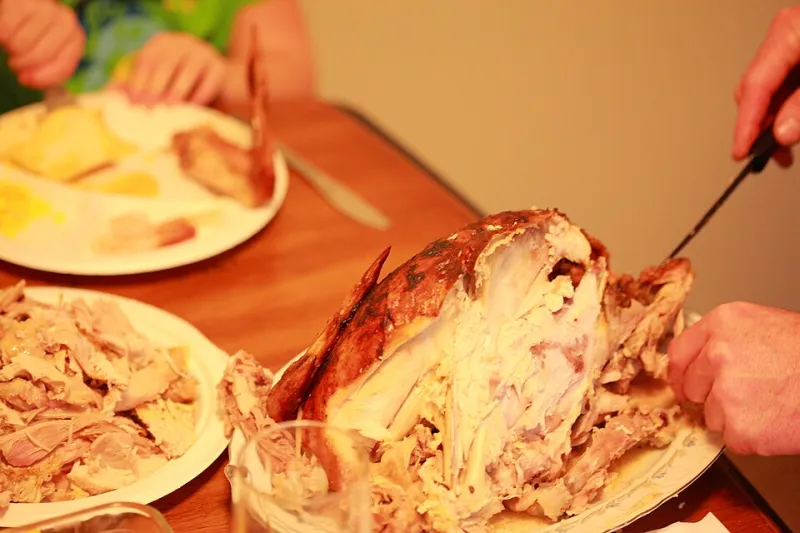
The Casserole Has Three Founding Fathers and None of Them Agree
Photo: Thanksgiving recipe cards on kitchen table with laptop and smartphone, family recipe email chain, via cdn.tasteatlas.com
Every November, my family performs a small ritual: someone texts “Can you send me Grandma’s casserole recipe?” and within hours, the group chat becomes a minor constitutional crisis. This year, I decided to fix it. I would make one shared document. One source of truth. One calm, searchable, holiday-ready archive of the dishes we actually eat.
I want to be clear that I believed this was a good idea. I also believed, briefly, that I could be the neutral party. In 2026, that is roughly the same energy as volunteering to moderate a family debate about stuffing while holding the only working oven mitt.
The Spreadsheet Was Supposed to Be the Easy Part
My plan was simple. Create a shared doc, invite the usual suspects, and let everyone paste their recipes into clearly labeled sections. Appetizers. Sides. Desserts. A separate tab for “things Aunt Linda will ask about and then not make.”
Within an hour, I had three comments, two suggested edits, and one cousin asking whether the doc was “the official one or the other official one.” There was no other official one. There was only my doc, plus the email chain from 2019 that nobody had deleted, plus a screenshot of a recipe card that had been forwarded so many times the butter amount looked like a small smudge.
This is the part where inherited recipes stop being food and start being lore. Everyone has a version. Everyone’s version is correct. And everyone can produce a witness.
Three Versions of the Same Casserole Walk Into a Doc
The casserole was the first casualty. I received three recipes with the same name and almost no overlap.
Version one called for cream of mushroom soup, sharp cheddar, and a topping made from crushed crackers. Version two insisted the crackers were wrong and used breadcrumbs, plus a half-teaspoon of something described only as “the good paprika.” Version three arrived as a photo of a handwritten card with a note in the margin: “Do NOT let [redacted] double the sauce.”
I put all three in the doc under a heading called “Casserole: Historical Editions.” That was my first mistake. The heading was interpreted as a challenge.
One cousin added a comment: “This isn’t how we make it.” Another replied: “This is exactly how we make it.” A third asked whether we could just vote. We could not just vote. Voting implies a shared set of facts. We had a shared set of feelings and a casserole with three founding fathers.
The Case of the Missing Secret Ingredient
Somewhere in the email chain, a message surfaced from an older thread with the subject line “Re: Re: Re: Re: Thanksgiving.” It mentioned a “secret ingredient” in the casserole. The message did not name the ingredient. It said only that “everyone knows.”
Everyone did not know.
I asked for clarification. I received a voice memo. Then another voice memo. Then a text that said, “It’s in the card.” The card had a stain over the exact spot where the ingredient should have been. It was either a spice, a condiment, or a family secret protected by a binding oral agreement.
At one point, a message was deleted from the chain. I noticed because the reply beneath it said, “Good call.” I will never know what was removed. I have chosen to believe it was a typo. My aunt has chosen to believe it was the truth. My cousin has chosen to send me a 90-second voice memo in which the phrase “you had to be there” appears four times.
Voice Memos From the Front Lines
Speaking of my cousin: he does not type. He does not email. He communicates exclusively in voice memos that begin mid-thought and end before the useful part. One memo was 47 seconds of background noise, followed by “ — so yeah, just use the pan.” Which pan? The memo did not say. The memo had already ended.
I tried to summarize his notes in the doc. I wrote: “Use the pan.” A second cousin replied, “Which pan?” I wrote: “The pan.” This was not helpful. It was, however, accurate to the source material.
The doc became less a recipe archive and more a record of what happens when a family tries to convert oral tradition into editable text. There were comments about oven temperatures. There were comments about whether “a stick of butter” meant a half cup or “the whole situation.” There was a long thread about whether the casserole should be assembled the night before or the morning of. Nobody changed their mind. Everybody changed the doc.
What Actually Made It to the Table
Here is the part where I admit that the shared doc did not produce a single definitive recipe. It produced a ceasefire.
By the Sunday before Thanksgiving, I had three versions of the casserole, two versions of the stuffing, and one very confident note about gravy that I chose to ignore because gravy is a separate negotiation and I have limits.
So I made a decision. I would cook the casserole my way — the version I grew up with, the one with the crackers and the sharp cheddar — and I would put the other two versions in a small binder labeled “Family Editions.” If anyone asked, I would say I was preserving tradition. If anyone pushed, I would say the oven was full. Both statements were true.
On Thanksgiving Day, the casserole disappeared before the turkey was fully carved. Nobody asked which version it was. Nobody requested a vote. My cousin sent a voice memo that said, “That’s the one,” and then, after a pause, “mostly.” I took the win.
The Real Recipe Is the Negotiation
The doc is still live. It has 14 comments, three suggested edits, and one unresolved question about paprika. I have not closed it. Closing it would feel like ending the conversation, and the conversation is the actual family recipe — the part where everyone insists they remember it correctly, the part where a missing ingredient becomes a mystery, the part where a cousin refuses to type.
Next year, I may try a group chat. Or a shared calendar. Or a simple rule: bring the dish, bring the card, and leave the email chain alone. But I suspect the chain will find us anyway. It always does. And someone will reply all.